Showing posts with label Intel. Show all posts

Posted by timothy on Friday January 29, @08:34PM
from the toward-marginal-cost dept.
Charbax writes "The Android laptops are coming. Thanks to cheap ARM-powered laptops made in China, and the latest, most optimized Android software, we can soon buy usable $100 laptops in all the supermarkets. In this video, I test the web browsing speed on the new Rockchip rk2808 ARM9-based PWS700CA laptop by Shenzhen-based Hivision Co Ltd. Web browsing on AJAX-heavy websites is surprisingly snappy, and could only be even faster if ARM11, ARM Cortex A8 or A9 processors were used and if it was configured with slightly more than 128MB RAM. How soon will Google release the $100 Google laptop?"


I don’t usually discuss PC, workstation, and server processors because I’m all about embedded processors these days. But Intel’s photo of the first Core i7 processor stopped me and I thought I’d write something. Here’s the photo:

The image shows four x86 processor cores arrayed across the top. Each core runs at 2.66 GHz (faster cores that exceed 3 GHz will appear in the future). Each of the four on-chip processor cores has its own 64-Kbyte L1 and 256-Kbyte L2 caches. The four on-chip processor cores share an on-chip, 8-Mbyte L3 cache and, of course, main memory external to the chip. An integrated, high-speed DDR3 memory controller links that off-chip main memory to the processor chip. In all, this is a very powerful machine.

Unfortunately, I get the impression from my many conversations with embedded systems designers that a lot of embedded designers think this is the right way to architect embedded systems. When they see three levels of on-chip cache used for this class of processor, they start to believe that all processors need caches—that cache memories are just part of the game now. What they forget or ignore is that processors in the same league with Intel’s Core i7 chip cost hundreds of dollars and dissipate many tens of Watts. This is a great league, but it’s not the embedded league.

INTEL (TICKER: INTC) and Nokia (NOK) announced a strategic alliance to develop Intel architecture-based mobile chips and open-source software. The goal appears to be creating open and standards-based technologies to explore new ideas and products in mobile computing and communications.

Collaborative efforts between the two companies will be centered around these three initiatives: definition of mobile chipset based on Intel architecture; development of open-source software infrastructure such as Nokia's Maemo and Intel's Moblin; and Intel licensing of Nokia's HSPA/3G modem internet protocol ...


Intel and Taiwan Semiconductor Manufacturing Company (TSMC), one of the world’s largest chip foundries, just announced a marketing collaboration involving Intel’s Atom processor. Atom is Intel’s effort to downsize its processor chips to fit into the realm of emerging smart devices below the Personal Computer space. TSMC will work closely with Intel to port some of the Atom processors to its own process and design flows. TSMC will also have the ability to do engineering on the chip to build customized versions for the large number of existing TSMC customers. However, Intel will have ownership of the final device and the customer, as Intel will be selling the custom designed chips that TSMC designs and builds in its foundry.

As PC sales wane, and their chip revenues along with them, Intel looks to additional sources for revenues. Consumer products represent a massive potential market, though at clearly lower margins and price points. But, Intel’s cost of operations makes it a supplier at too high a price to go after the cut-throat and highly price sensitive consumer market. And Intel is not set up for customized, System On Chip (SOC) solutions the market demands. Enter a partner that can bring all of this capability to Intel – TSMC.

This is a direct attack by Intel on competing processors, especially the ARM processor, which is trying to move upstream from the smart phone and embedded gadgets market it currently dominates, while Intel is trying to move downstream with Atom into this overlapping space. The battleground in the middle will be aggressive and likely bloody, with huge potential returns. And while Intel’s attack is primarily on ARM, it also has profound effect on other players – AMD, Qualcomm (Snapdragon), Nvidia, TI, and even Marvel to whom Intel sold off its own ARM-based processor (XSc


Intel and Taiwan Semiconductor Manufacturing Company (TSMC), one of the world’s largest chip foundries, just announced a marketing collaboration involving Intel’s Atom processor. Atom is Intel’s effort to downsize its processor chips to fit into the realm of emerging smart devices below the Personal Computer space. TSMC will work closely with Intel to port some of the Atom processors to its own process and design flows. TSMC will also have the ability to do engineering on the chip to build customized versions for the large number of existing TSMC customers. However, Intel will have ownership of the final device and the customer, as Intel will be selling the custom designed chips that TSMC designs and builds in its foundry.

As PC sales wane, and their chip revenues along with them, Intel looks to additional sources for revenues. Consumer products represent a massive potential market, though at clearly lower margins and price points. But, Intel’s cost of operations makes it a supplier at too high a price to go after the cut-throat and highly price sensitive consumer market. And Intel is not set up for customized, System On Chip (SOC) solutions the market demands. Enter a partner that can bring all of this capability to Intel – TSMC.

This is a direct attack by Intel on competing processors, especially the ARM processor, which is trying to move upstream from the smart phone and embedded gadgets market it currently dominates, while Intel is trying to move downstream with Atom into this overlapping space. The battleground in the middle will be aggressive and likely bloody, with huge potential returns. And while Intel’s attack is primarily on ARM, it also has profound effect on other players – AMD, Qualcomm (Snapdragon), Nvidia, TI, and even Marvel to whom Intel sold off its own ARM-based processor (XSc


I don’t usually discuss PC, workstation, and server processors because I’m all about embedded processors these days. But Intel’s photo of the first Core i7 processor stopped me and I thought I’d write something. Here’s the photo:

The image shows four x86 processor cores arrayed across the top. Each core runs at 2.66 GHz (faster cores that exceed 3 GHz will appear in the future). Each of the four on-chip processor cores has its own 64-Kbyte L1 and 256-Kbyte L2 caches. The four on-chip processor cores share an on-chip, 8-Mbyte L3 cache and, of course, main memory external to the chip. An integrated, high-speed DDR3 memory controller links that off-chip main memory to the processor chip. In all, this is a very powerful machine.

Unfortunately, I get the impression from my many conversations with embedded systems designers that a lot of embedded designers think this is the right way to architect embedded systems. When they see three levels of on-chip cache used for this class of processor, they start to believe that all processors need caches—that cache memories are just part of the game now. What they forget or ignore is that processors in the same league with Intel’s Core i7 chip cost hundreds of dollars and dissipate many tens of Watts. This is a great league, but it’s not the embedded league.

Intel Core 2 Quad Q8200 / 2.33 GHz processor Quad-Core

Leaders of the pack seeking monster performance, look no further. With four execution cores, the Intel Core 2 Quad processor blows through processor-intensive tasks in demanding multitasking environments and makes the most of highly threaded applications. Whether you're creating multimedia, annihilating your gaming enemies, or running compute-intensive applications at one time, new quad-core processing will change the way you do everything. Pioneer the new world of quad-core and unleash the power of multithreading.
General

* MPN: BX80580Q8200
* Product Type: Processor

Processor

* Type / Form Factor: Intel Core 2 Quad Q8200
* Multi-Core Technology: Quad-Core
* 64-bit Computing: Yes
* Processor Qty: 1
* Clock Speed: 2.33 GHz
* Bus Speed: 1333 MHz
* Compatible Processor Socket: LGA775 Socket
* Manufacturing Process: 45 nm
* Thermal Design Power: 95 W
* Thermal Specification: 71.4 °C
* Architecture Features: Enhanced SpeedStep technology, Execute Disable Bit capability, Intel 64 Technology, Enhanced Halt State (C1E), Intel Thermal Monitor 2

Cache memory

* Installed Size: L2 cache - 4 MB

Expansion / connectivity

* Compatible Slots: 1 x processor - LGA775 Socket


Miscellaneous

* Package Type: Intel Boxed

Manufacturer warranty

* Service & Support: 3 years warranty

Intel® EP80579

Based on Intel® architecture, the Intel® EP80579 Integrated Processor product line is the first in a series of breakthrough system on-a-chip (SOC) processors, delivering excellent performance-per-watt for small form factor designs.

This fully compatible product line (Intel EP80579 Integrated Processor and Intel® EP80579 Integrated Processor with Intel® QuickAssist Technology) provides an outstanding combination of performance, power efficiency, footprint savings and cost-effectiveness compared to discrete, multi-chip solutions.

These integrated processors are ideal for small-to-medium business (SMB) and enterprise security and communications appliances (including VPN/firewall and unified threat management), transaction terminals, interactive clients, print and imaging applications, wireless and WiMax access applications, SMB and home network attached storage, converged IP PBX solutions, converged access platforms, IP media servers, VoIP gateways and industrial automation applications.


For Embedded Computing

The Intel® Xeon® processor is the solution for specific communication applications that require the highest levels of processing performance - such as web-serving, storage (NAS, SAN), search engines, telecommunications servers, network management, security, voice, and load balancing. When coupled with the Intel® E7500, Intel® E7501 or Intel® E7520 chipsets, the Intel Xeon processor provides high memory bandwidth, high memory capacity, and high I/O bandwidth. With 1M or 512K L2 Advanced Transfer Cache, the Intel Xeon processor along with the Intel E7500, Intel E7501 or Intel E7520 chipset creates a balanced platform that is ideal for delivering unparalleled price-performance, scalability and flexibility. Low Voltage Intel® Xeon® Processors - The Low Voltage Intel® Xeon® processor has the added benefit of lower thermal design power making it ideal for thermally-sensitive, space-constrained environments. When coupled with the Intel E7500, Intel E7501 or the E7520 chipsets, the Low Voltage Intel Xeon processor delivers compelling value in a variety of network infrastructure applications including web-serving, search engines, telecommunications servers, network management, security, voice, and load balancing.


Features and benefits

400 MHz low power processor system bus Supports 400 MHz system bus for single processor configurations.
Support for up to 2 GB of DDR 333/266/200 memory technology Higher performance & flexibility.
Integrated high-speed USB 2.0 Support for USB 2.0 peripherals for 40X faster data transfer rate and backward compatible to support USB 1.0 devices.
AGP4X interface High-bandwidth interface to provide flexible support for high performance mobile discrete graphics solutions.
Intel® Stable Image technology Enables chipset HW changes, minimizing impact to IT SW image stability.
Dynamic input/output buffer disabling for processor system bus & memory Reduces chipset power consumption by Intelligent activation or power-down of the processor system bus or memory.


Intel's Atom processor was prominently displayed in systems at a conference in Japan. The chipmaker's next-generation X4500 graphics also made an appearance.

Atom logo

Small systems and circuit boards using the Atom processor appeared on the Web site PC Watch, which highlighted designs at a "Systems Expo" in Tokyo.

A host of small devices with the Atom processor are due in June. The 45-nanometer chip will compete with processors from Via Technologies such as the C7 and upcoming Isaiah processor.

Small PCs and computer systems using the low-power Atom processor included a small embedded computer from Japan-based Dux, a car "infotainment" system from Portwell Japan, and a motherboard for mobile internet devices from Sophia Systems.

Advantech was also showing an Atom-based circuit board as was Nagano. A 1.6GHz Atom-based board from Omron was on display too.

And that's not the only upcoming Intel chip that made an appearance. A board was shown with Intel's upcoming X4500 graphics silicon. The X4500 is slated to be part of the forthcoming GM45 ("Cantiga") chipset for the mobile Centrino 2 platform and the G45 ("Eaglelake-G") chipset for desktops.

While the marquee processor theme at IDF Shanghai is "milliwatts to petaflops," Intel is also set to offer a vision of universal connectivity.

The main theme for the event, which starts Wednesday, Beijing time, refers to "very, very big to very, very small and low power," according to Pat Gelsinger, senior vice president and co-general manager of Intel's digital enterprise group, speaking in a video.

"Milliwatts" refers to chips such as Atom, a tiny low-power, low-cost processor destined for ultramobile devices and low-cost desktops typically running either Linux or Windows XP. The first Atom chips will launch in June.

"Petaflops" refers to high-performance computing--what used to be called supercomputing. ("Peta" is quadrillion, or a thousand trillion; "flop" is floating-point operation.) Intel is targeting petaflop supercomputers that would compete with the fastest supercomputer in the world: IBM's Blue Gene/P machines.

Though more technology and product details will certainly emerge in the next two days in Shanghai, the main chip themes are already out there. Gelsinger spelled them out at briefing earlier this month.

Intel Dunnington processor

The chip buzzwords are: Tukwila, a new quad-core chip with 2 billion transistors, a whopping 30MB of cache, and a new interconnect technology called QuickPath; Dunnington, a six-core chip for multiprocessor computers that can support four or more processors (in this case, each with six cores); Nehalem, a follow-on to the current "Penryn" processors, it is a new 45-nanometer chip microarchitecture due in the fourth quarter that scales up to eight cores; and Larrabee, a visual-computing architecture that uses many cores ("many" usually means many more than a typical quad-core computer).

In addition to Atom, the processor spotlight will likely fall on Nehalem and Larrabee. Nehalem is a relatively known quantity; Larrabee, a relatively unknown quantity. So interest should focus on the latter.

Nehalem boasts increased parallelism, better branch prediction (to move instructions more quickly through the instruction pipeline), and an on-chip memory controller for increased memory performance--what Intel calls "memory latency reduction." Something, by the way, Advanced Micro Devices already has in its chips.

Larrabee is a graphics processor scheduled for the 2009-2010 time frame. It will include a new vector instruction set to improve the performance of graphics and video applications. Larrabee will be compatible with Intel's popular x86 instruction set, theoretically making life easier for software developers.

On another front, Intel is evangelizing universal connectivity, always a problematic proposition, simply because it invariably promises more (sometimes much more) than it can deliver. Intel puts it this way: "Imagine a day when a single device small enough to fit in your pocket...knows your tendencies and preferences and can adapt and optimize its interfaces to match what you are doing at any point any time...Imagine a day when this device...can dynamically become a hybrid combination of other computing and multimedia devices in close proximity." You get the picture. Intel calls this "Carry Small, Live Large."

On a slightly more practical level, the Cliffside technology is being demonstrated from the Mobile Products Group; it enables a single Wi-Fi adapter to function like two independent Wi-Fi adapters. The hope is that this technology could sync your MP3 and video files without a USB cable, directly and wirelessly connecting your notebook to your TV to view HD movies.

What’s in a name? If you’re Intel, there’s plenty of brand equity in names like Atom, Centrino, Core and Pentium. But there’s also a fair share of confusion, too, among consumers and IT buyers.

And so, Intel is planning on revamping its portfolio of brand names, an effort that revolves around a good-better-best format. In a statement, the company said:

…we are focusing our strategy around a primary ‘hero’ client brand which is Intel Core. Today the Intel Core brand has a mind boggling array of derivatives (such as Core 2 Duo and Core 2 Quad, etc). Over time those will go away in its place will be a simplified family of Core processors spanning multiple levels: Intel Core i3 processor, Intel Core i5 processor, and Intel Core i7 processors. Core i3 and Core i5 are new modifiers and join the previously announced Intel Core i7 to round out the family structure. It is important to note that these are not brands but modifiers to the Intel Core brand that signal different features and benefits. For example, upcoming processors such as Lynnfield (desktop) will carry the Intel Core brand, but will be available as either Intel Core i5 or Intel Core i7 depending upon the feature set and capability. Clarksfield (mobile) will have the Intel Core i7 name.

So glad Intel has taken the complexity out of it. Actually, the company acknowledges that there will be multiple brands in the market next year, including the old names, as the company makes the transition.

Under the Core brand, the i3 represents the entry-level of the Core family, with Core i5 and Core i7 representing the mid-level and high-level products. Celeron will stick around for entry-level computing, Pentium for basic computing and Atom for devices such as netbooks and smartphones. For PCs, think of Celeron being good, Pentium being better and Core being best.

Even Centrino, which came to be synonymous with wireless computing, won’t completely go away. The company plans to transition the name to WiFi and WiMax products next year.


Intel showed what it considers the smallest PC motherboard in the world at the Intel Developers Forum (IDF) in Shanghai. The motherboard, or main PC circuit board, will go into the company's next-generation "Moorestown" mobile Internet device (MID) platform due in the 2009-2010 time frame.

Intel's Anand Chandrasekher holding motherboard

"Our engineers have been very hard at work on Moorestown," Anand Chandrasekher, senior vice president and general manager of Intel's Ultra Mobility Group, said during an IDF keynote speech Wednesday. "The platform design teams have been hard at work in figuring out what is the smallest form factor that they can actually fit a complete PC motherboard into so they can deliver a great mobile Internet experience."

"What I'm holding in my hand is what is possibly the world's smallest PC motherboard," Chandrasekher said. The Moorestown motherboard houses the processor, chipset (including graphics), and memory, along with silicon for 3G, Wi-Fi, Bluetooth, and GPS, he said. "This is the heart of the new machine."

Moorestown will be Intel's showcase system-on-a-chip, combining the CPU, graphics, and memory controller (and other silicon mentioned above) on a single die. It will likely be the main launching pad for Intel into the mobile phone market--what the chipmaker calls "MID phones." Moorestown may also be a major market for Intel's upcoming solid-state drives.

Intel Moorestown platform


Intel announced a technology partnership with Nokia that could potentially give the chip maker the breakthrough it has been looking for into the mobile market.

The companies said last night they would work together on a new class of mobile computing devices, but would not say when they would come to market or give details on the kind of wireless products they hoped to develop together.

Analysts saw the pact as strategically important for Intel in the long term because it gains the world's top cellphone maker as a potential client.

But given the lack of details, analysts said it could take one or two years for products to come to market, and it remained to be seen if they would find favour with consumers.

"Intel at least has its foot in the door. It's an important and strategic customer," said Gartner analyst Jon Erensen, who sees the partnership as a way for Intel to get into the market for advanced phones known as smartphones.

However, he added, "You're probably talking about something like 2011 before you get down to the power consumption and integration (levels) you'd need for that kind of device."

Analysts said the deal gives Intel a chance to take on leading cellphone chip makers Qualcomm Inc and Texas Instruments, a big Nokia supplier.

It could also mean stiffer competition for ARM Holdings , which supplies core cellphone processors to both Texas Instruments and Qualcomm, and whose customers rely in part on software from Wind River Systems.

Intel said earlier this month that it would buy Wind River, whose software speeds up and connects devices made by Samsung Electronics, Apple, Hewlett-Packard Co and Motorola.

Intel, whose microprocessors are found in eight out of 10 personal computers, already works with LG Electronics on mobile devices. The agreement with Finland's Nokia, the world's largest cellphone maker, is a bigger step.

Intel Chief Executive Paul Otellini has said that the handheld, embedded and netbook markets would be as important for the company as the PC market in the near future.

Under the agreement, Intel will buy intellectual property from Nokia related to high-speed wireless technology. They also plan to collaborate on open-source mobile Linux software projects, which some analysts say will compete with Google's Android software in the netbook and mobile Internet device (MID) market.

Intel and Nokia said they aimed to define "a new mobile platform beyond today's smartphones, notebooks and netbooks" for hardware, software and mobile Internet services. They stressed the pact was about their technology collaboration and not about specific products.

NZXT Beta - Unboxing and Specifications

NZXT has been putting out quite a few cases since 2003, and from budget to higher end models they likely have a case to suit just about anybody. Their mid-tower Beta case is aimed more for the budget-minded enthusiast with a retail price of just south of $50.00. When NZXT offered to send us the Beta case to evaluate, we were more than happy to accommodate them.

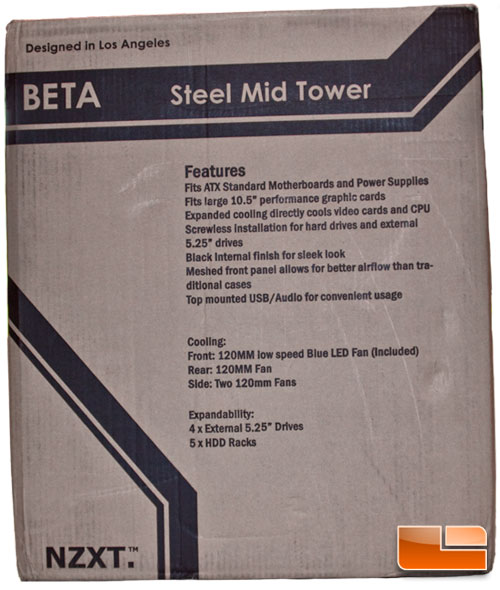
NZXT Beta Box

After pulling the NZXT Beta out of the box I noticed right away how light it is at just a hair over 16 lbs (7.28kg) which was a little unexpected with this being a steel case. This made me wonder about the build quality which I will speak more about later.

NZXT Beta Case

NZXT has listed the features and specifications for the Beta are as follows:

FEATURES:
  • Fits ATX standard motherboards and power supplies
  • Fits large 10.5" performance graphics cards
  • Expanded cooling directly cools video cards and CPU
  • Screwless installation for hard drives and external 5.25" drives
  • Black internal finish for sleek look
  • Meshed front panel allows for better airflow than traditional cases
  • Top mounted Dual USB/Audio/ESATA for convenient usage
SPECIFICATIONS
  • Case Type: Mid Tower
  • Front Panel Material: Plastic
  • Dimensions (W x H x D): 200 X 430 X 501 mm / 7.87" x 16.9" x 19.7"
  • Cooling System:
    • Front, 1 X 120mm Blue LED (included)
    • Rear: 1 X 120mm
    • Side: 2 x 120mm
  • Drive Bays: 9 Drive Bays
    • (4) External 5.25" Drive Bays
    • (5) Internal 3.5" Drive Bays
  • Screwless Rail Design
  • Material: Steel with black finish
  • Expansion Slots: 7
  • Power Supply: 500 Watt PS2 ATX 12V 2.0 (optional)
  • Weight: 7.28 KGS (W/O Power)
  • Motherboard Support: ATX, MICRO-ATX, BABY AT

What you'll find in the box besides the case is an accessory box packed neatly within the case itself.

NZXT Beta Accessory Box Inside Case

Opening it up reveals the contents comprised of HDD drive mount rails, 5.25" & 3.5" bay screwless plastic locks, a small bag of screws and a case speaker.

NZXT Beta Accessories

What you won't find in the box is a manual because it isn't included. However, a nice multilingual thank you note in the box directs you to the web for the manual via PDF download. This is pretty common now, especially with budget products and I personally don't mind NZXT and others keeping their costs low by skipping the hard copy print. Most people toss it after installation anyway. It's always a good idea to grab a copy of the manual if for nothing else than to confirm the polarity of the chassis wires for the power, reset buttons and others.

Very good Speed and unbelieveable performance and The Dual-Core Intel Xeon processor 5100 series is ideal for intense computing environments, 32-bit and 64-bit business-critical applications and high-end workstation and Analysis in my mind Dual-Core Intel Xeon processor 5100 series-based platforms are expected to deliver up to 2.25 times the performance and 2.35 times the performance/watt of previous-generation dual-core Intel Xeon processors and realiable performance and I always advice my friends,visiter and colike. In my view overall good performance Easily purchase. Good Manufacture support and overall we see performance,efficiency,design very valuable. Mostly people perfer and All this report in my survey and judge 80% people perfer this and I also recommend you please purchase.


Want to prosecute people who are downloading files illegally? Well, if you fine them, you might be taking money out of the hands of your best customers, a new survey shows.

It's not the first such survey to come to this conclusion. However, it is the latest.

The study, published on Sunday by U.K. think tank Demos, surveyed 1,008 people aged between 18 and 50 last month. It found that those who admit to illegally downloading music spent an average of £77 a year on music, which is £33 more than those who claim that they never do so.

The British Phonographic Industry estimates that seven million U.K. users download files illegally annually, which will cost the industry £200 million this year. Assuming, however, that the survey held true, the extra £33 spent annually by each of those seven million would add up to £231 million. Hey, that's a profit of £31 million!

Seriously, the study also noted that lowering the price for legally downloaded music could result in a significant decrease in illegal downloads. The sweet spot would seem to be 45p per track. Currently, tracks on iTunes run between 59p and 99p; the survey indicated that sales could double at that price.

Naturally, the music industry wasn't too impressed with the survey. Recent proposals, include a "three strikes, you're out" policy which would terminate broadband service if consumers fail to respond to warning letters; the industry believes this will deter illegal downloaders.

Meanwhile, some, including Forrester Research, have a different view. Mark Mulligan of Forrester Research said, "The people who file-share are the ones who are interested in music. They use file-sharing as a discovery mechanism. We have a generation of young people who don't have any concept of music as a paid-for commodity. You need to have it at a price point you won't notice."

This same argument has been made for downloaders of other material, such as PC games; many say they download as a sort of "try and buy" method. In terms of this survey, 83% said they buy more music as a result, and 42% said they did so to "try before you buy."

Of course, this doesn't change the fact that illegal downloading is still stealing. It is evident, however, that many younger people just don't see it that way.


Developed to aid students in their classroom learning, the PC features an Intel Processor 900 Mhz, WiFi and Ethernet connectivity, water-resistant keyboard, a 7-inch LCD screen, 215 MB and 512 MB RAM with 1 GB and 2 GB flash memory. With the Classmate PC, Intel-HCl will also offer note taker and digital pens.

Furthermore, Intel is also working with Educomp, leading educational service provider, for the design, development, prototype creation and proof of concept of Classmate PCs.
“It is priced in the sub-Rs 18,000 range but it also includes the cost of installing supporting connectivity infrastructure, teachers’ training and customized integrated learning solutions through our tie-up with content developers and education service provider. Later, the cost will go down further,” said Rajendra Kumar, HCL Infosystems Executive Vice-president.
Classmate PCs will be retailed through schools and HCL Infosystems and also by Intel OEM partners Wipro and Zenith shortly in August-September 2007. It is expected to deploy 3,000-5,000 such PCs over the next nine months to a year.

The LGA1366 interposer (from ASSET InterTech) enables design, test and field repair engineers to access the debug port on the Intel Xeon Processor 5500 Series and Core i7 processors (based on Intel’s new Nehalem microarchitecture) after the processors have been placed on a circuit board. The LGA1366 interposer’s standard Intel debug port (XDP) header connector enables third-party CPU emulation tools to access the Intel Xeon processor 5500 series and Core i7 processor debug ports, even when a XDP header is not provided on the circuit board. The LGA1366 interposer is available now with pricing starting at $2,900.


ASSET InterTech LGA1366 interposer

The LGA1366 interposer features a direct interface between the CPU on an assembled circuit board and PCT on the ScanWorks platform. The non-intrusive PCT test technology can apply tests, diagnostics, and debug routines to the entire circuit board through the Intel processor without placing physical probes anywhere on the board. Unlike intrusive test technologies like ICT, which require expensive bed-of-nails fixtures for testing circuit boards, PCT on ScanWorks is a non-intrusive technology that relies on software. It tests the electrical integrity of a board and applies functional tests at processor speeds through the CPU’s debug port.

In addition to the enhanced test coverage that ASSET’s interposers and top-side adapters make possible in manufacturing, they can also be applied very effectively in repair operations. Some circuit boards are broken to the point where they cannot launch an operating system (OS) or even the kernel of the OS, the Basic Input/Output System (BIOS). Since most functional test techniques require a running BIOS or OS, traditional functional tests cannot be performed on these circuit boards and they cannot be repaired. Fortunately, ScanWorks’ PCT tests do not require an OS or BIOS. As a result, the precise diagnostics of PCT can locate faults and failures on otherwise dead circuit boards. The manufacturer can then repair these boards and recoup some of the costs associated with them.

Cost and size considerations often cause many circuit board manufacturers to either remove the circuitry required to access the processor’s debug port or to remove the connectors on the circuit board which would link to this circuitry. ASSET’s interposers and top-side adapters overcome this problem for the purposes of the more cost-effective non-intrusive board test technologies such as processor-controlled test (PCT) on ASSET’s ScanWorks platform for embedded instrumentation. In addition to providing a lower cost-of-test, non-intrusive board test (NBT) also offers improved test coverage over the older intrusive test technologies such as in-circuit test (ICT).